

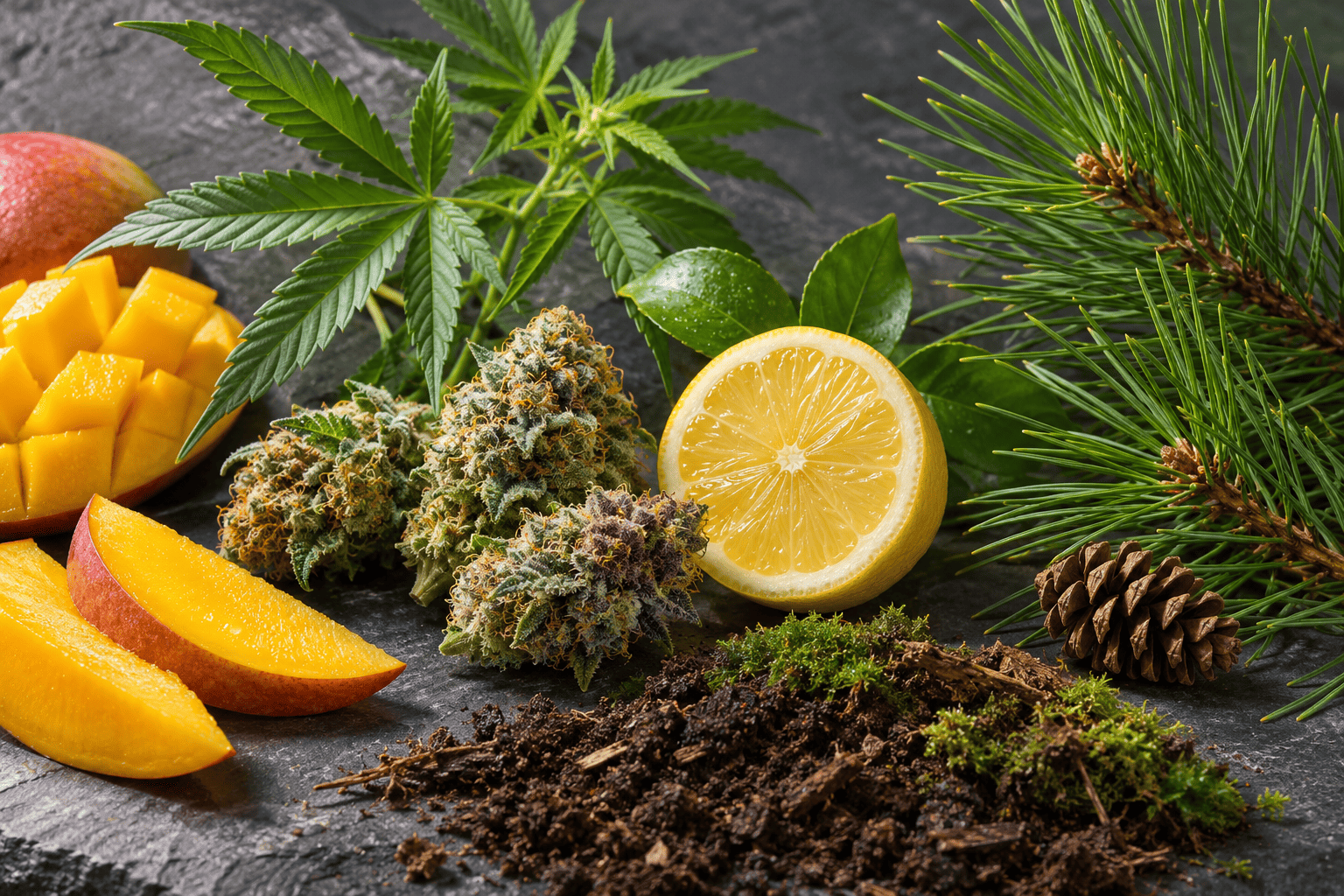
One cannabis flower smells like lemon peel. Another brings to mind pine needles, herbs or damp earth. What creates those differences?
Terpenes are part of the answer. These naturally occurring compounds contribute to the aromas of cannabis and many other plants. Understanding them can help you make sense of descriptions such as “citrusy,” “woody” and “herbal.”
Their role in how cannabis makes you feel is more complicated. Here’s what terpenes are, how three common examples differ, and what the science means for you.

Terpenes are compounds produced by plants, including cannabis. Many are aromatic, meaning they contribute to a plant’s scent.
In cannabis, terpene-rich resin accumulates in tiny structures called glandular trichomes. These are the resin-producing glands that give cannabis flower much of its frosty appearance. Researchers have identified enzymes in cannabis that produce terpenes including myrcene, limonene and pinene. journals.plos.org
A terpene profile describes the combination of terpenes detected in a sample and their measured amounts. Different varieties can have different profiles, helping explain some of their differences in aroma. pmc.ncbi.nlm.nih.gov
Cannabis aroma comes from a mixture of compounds. Terpenes contribute familiar notes, but other substances also play a role.
Research has identified sulfur-containing compounds that contribute to cannabis’s distinctive skunky scent. Other compounds can contribute tropical, citrus or savoury notes, even when present in small amounts. pubmed.ncbi.nlm.nih.gov
This explains why two flowers can contain some of the same terpenes and still smell different. Knowing the most abundant terpene gives you one piece of information. The full mixture shapes the aroma.
Myrcene, limonene and pinene are a useful starting point for understanding the language of cannabis aroma.
Myrcene is commonly described as earthy, musky and herbal. It is one of the terpenes frequently discussed in cannabis research and can be a major component of some varieties’ terpene profiles.
For readers, “myrcene” is best understood as a chemical name associated with a particular range of aromas. Its presence alone cannot establish how a flower will affect an individual.
Curious about earthier aromas?
PINK KUSH SMALLS lists myrcene in its terpene profile.
Limonene has a recognisable citrus aroma associated with lemons and oranges. It is also among the terpenes commonly identified in cannabis.
A citrus description does not establish how much limonene a sample contains. Other aromatic compounds can also contribute citrus notes, so scent and laboratory measurements provide different kinds of information.
If citrus notes caught your attention, take a look at ON POINT PHENOTYPE #2, which lists limonene in its terpene profile.
Pinene is associated with fresh, pine-like aromas. You may see two forms listed in research or laboratory results, alpha-pinene and beta-pinene.
These names identify related compounds. A pine-like scent is a useful sensory description, while a terpene analysis identifies what was measured in the sample.
Prefer a fresh, pine-like aroma?BLUEBERRY lists pinene in its terpene profile.
Myrcene, limonene and pinene are all documented components of cannabis chemistry. Their familiar aroma descriptions provide a starting point for recognising scent families. journals.plos.org
Researchers are studying whether terpenes influence the effects of THC and other cannabis compounds. The evidence is developing, and results depend on the terpene, dose and experimental conditions.
For example, a controlled human study investigated THC combined with D-limonene and found reduced anxiety-related effects under certain tested conditions. That finding does not establish that every limonene-containing cannabis flower produces the same response. The researchers also noted that many commonly repeated claims about cannabis interactions have received little controlled testing in humans. pmc.ncbi.nlm.nih.gov
For you, this means descriptions such as “relaxing terpene” or “energising terpene” need careful interpretation. A terpene name cannot reliably predict your experience. THC exposure and individual responses also matter. nida.nih.gov
The entourage effect is the idea that compounds in cannabis may interact and influence one another’s effects.
Scientists have tested parts of this idea, with differing results. Some experiments have found interactions, while others have found no effect through the specific biological mechanisms they examined. pubmed.ncbi.nlm.nih.gov
The term describes an area of research. It does not establish that a particular terpene combination will deliver a predictable benefit or a better experience.
A laboratory terpene report can tell you which terpenes were detected in the tested sample and their measured concentrations.
When reading one, check—
For example, 1% equals 10 milligrams per gram. That number describes concentration. It does not measure intoxication or establish a health benefit.
A scent description offers a different kind of information. “Lemon-like” describes an aroma someone noticed. It does not confirm a laboratory result for limonene.
Terpenes help explain the variety of aromas associated with cannabis. Learning their names makes descriptions easier to understand and gives you a clearer way to discuss what you smell.
They also show why cannabis cannot be described completely by one number or one compound. Even a detailed terpene report captures only part of its chemistry.
The most useful distinction is between aroma, measured composition and expected effects. An aroma describes a sensory impression. A laboratory report measures selected compounds. Predicting an individual’s response requires more information than either can provide alone.
Are terpenes the same as THC?
THC is a cannabinoid. Terpenes belong to a different group of compounds and contribute to cannabis aroma. A terpene percentage and a THC percentage describe different components of a sample. pmc.ncbi.nlm.nih.gov
Can you identify a terpene by smell?
Smell can suggest familiar aroma notes, but it cannot confirm a terpene’s identity or concentration. Cannabis contains a complex mixture of aromatic substances, including compounds beyond terpenes. pmc.ncbi.nlm.nih.gov
Does more terpene content mean stronger effects?
A higher total terpene measurement does not, by itself, establish stronger intoxication or greater benefits. Research into specific terpene interactions is still developing, and findings cannot be applied equally to every cannabis sample. pmc.ncbi.nlm.nih.gov

Copyright 2022 © All Rights Reserved.


45 Responses
I’d have to say my favourite would be caryophyllene, I am a huge fan of the spice and unique aroma that comes from it, its unlike any other and always provides a unique experience.
Great read for anyone who wants to learn more about terpenes. ALways love a good strain with a lot of limonene
Awesome blog post, appears to be well-researched too. I was imagining the smells in my pallet as I read through, yummy! Love pinene.
Great write up. Very informative….there is so much to learn!
Great post, with a ton of info to digest. I’m sure I’ll be skimming back over it a few times again in the future.
Was a good read, very interesting and informative. Love to learn more.
Just found my new World of Warcraft character names, You were just destroyed by alpha-pinene.
When I See how much variety it makes me completely crazy I do not have a favorite variety especially because I always try a new strain with each order
The medicine is important but the delivery system is very important as well.. need those terps!
Thanks for good read. I figured I liked limonene already and it’s nice to learn about other terps. I will likely reference this article in the future. Can’t wait for terp science to progress in these coming years!!
I was surprised to find a few of these new to myself. The examples of strains, foods and spices containing these terpenes will definitely help me narrow down what works for me in the future… Very interesting, thanks for the info.